
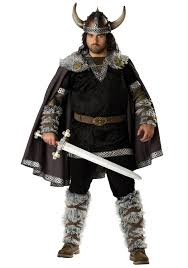
“Angelsakser! Giv mig din kvinde og dit penge. Du jan faa kvinden igen naar jeg er fertig med hende.” [“Saxon man, give me your woman and your money, or I will kill you. You can have the woman back when I have finished with her”]Those who have been following Sarah and Saga on TV will of course recognise that I have been forced by ignorance to use Modern Danish, rather than its earlier form, Old NorseWe have no outstanding news recordings, but it is very possible that, while ploughing his fields, Ethelbert Elm was confronted in 914 AD by the awful looking Bjorn (pictured here) with the above words.
Viking warrior
The Vikings lived in Scandinavia but from the 8th Century they used their longships to sail to places as far apart as Newfoundland and Turkey. They are perhaps most well known as raiders who launched brutal and then settlement in many cases.
Their contact with Britain followed the same pattern. Thus Vikings from Denmark attacked London in 842, first to plunder and later to settle. The Anglo-Saxons created a fortified settlement using the remains of the Roman wall. However, the Vikings were able to pass the winter in London in 871-72.
They settled increasingly in the North and East of England. The Saxons fought back and after burning the cakes, King Alfred was able in 878 force the Viking leader Guthrum to divide the country. The results of this can still be seen in place names ending in –by (Whitby) and –thorpe (Mablethorpe).
However, the attacks began again in the 10th century and in 991 King Ethelred was defeated at the Battle of Maldon (Essex) and was obliged to pay the Danegeld – 10 000 pounds (3,300kg of silver) to buy them off. The battle was described in an Anglo-Saxon poem, but there is a translation at www.battleofmaldon.org.uk. In it the Danish spokesman says:
“thou must send swiftly /Ring-money for pledges. For you were it better/That you buy off this spear-rush with your tax,/Than that we should have so hard a battle”.
Scholars differ, but it seems that in modern terms, this could have been about 50 million pounds. The result was as warned by Rudyard Kipling 000 years later That “if once you have paid him the Dane-geld, You never get rid of the Dane”. The payments went on for some 22 years.
Danish influence grew and in 1016 Cnut (or Canute as we call him to avoid embarrassing slips of the tongue) became King of England. Though his failure in the field of sea defences is well known, there was a prosperous and peaceful time during which Danish merchants came to London to trade. A Danish poem of the period celebrates this: “Back then the shield was stained with blood every day, when we set out on our expedition with the king. Now these hard battles are done with, we can settle down, lady, in beautiful London.”
The Danish rule ended when Edward the Confessor became king in 1042.
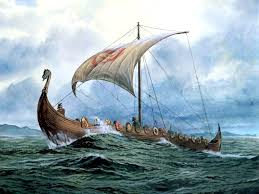
Viking ship
It should be clear from the above that though the Vikings were every much present in the London region, they built no settlements in our region. The River Fleet would not have been suitable for their relatively large, sea-going ships, but It is likely that the St Pancras area would have been a useful source of supply, as it was to the Saxons. And in the earlier stages of the invasions, our opening scenario could well have been all too frequent.
For more on the Vikings try