
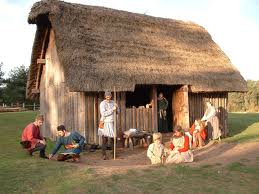
Very little is known about the Elm Village area in the Anglo-Saxon period (traditionally dated from the departure of the Romans in 410 to the arrival of William the Conqueror in 1066. But we do know that the area was divided into four manors:
- Tottenhall (hence Tottenham Court Road)
- Cantelowes (hence Cantelowes Road)
- St Pancras (around the church) and
- Rugmere (now Regent’s Park).
There are no maps giving us clear boundaries, but the general opinion is that Elm Village lies on land of Cantelowes Manor.
When William I had occupied the country he wanted to know what he had got – and how it could be taxed. So he sent inspectors to record all the important data. This was written down in the Domesday Book – you can see our entry
Elm Village back in the day
From the Domesday Book, we know that St Pancras was in in the Ossulstone Hundred (an administrative unit) – now remembered in Ossulston Street. There were 35 households (that is men who were heads of a family), so there were in fact probably 100 to 200 people. (Elm Village has 150 residences (households) so the population was probably about half that of the estate). The area consisted of “meadows, pasture and woodland”. We can only speculate whether the Elm Village area had been cleared by then.
We know that the population was of Saxon origin from the place names, notably “– ton” (modern “town”), hence Euston, Islington. The manors originally belonged to Saxon noblemen, but were given to the Canons of St Paul’s Cathedral, for whom they provided at that time an income of £3 a year. It is very hard to get an accurate estimate of what this means. Different sources suggest that £1 at that time is worth £783 to £33 000 in modern terms.
We do know that if Canon Walter had wished to buy a female slave it would have cost him between a sixth and a third of his annual income – but if he had raped her, records of fines suggest that he would have had to pay two years, rents (clergymen in those days were not always as moral as they are today). [Details of this type of calculation](http://www.regia.org/misc/costs.htm.).
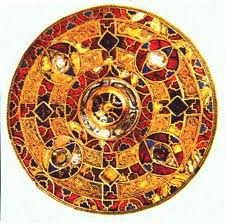
We think of Saxon men as wild and crude, swigging gallons of mead before fighting and fornicating. But archaeology shows is us that they had a remarkable level of craftsmanship.
Some texts survive which give us a better idea of how life was for the Saxons. For instance, this could well have described the plough land of our area:
Acres bountiful bringing to harvest/Tall stalks and shining growth/Acres of broad harvest of barley/Acres of white harvest of wheat/And all the harvests of earth.
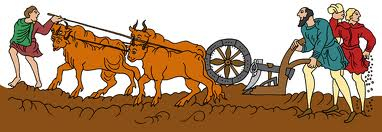
Were the Saxons ploughing Elm Village centuries before Lord Agar build his Lodge here?
And our ancestors were not without humour. They liked riddles. So what is this one talking about?
I am a wonderful help to women, The hope of something to come. I harm no citizen except my slayer. Rooted I stand on a high bed. I am shaggy below. Sometimes the beautiful peasant’s daughter, an eager-armed, proud woman grabs my body, rushes at my red skin, holds me hard, claims my head, confines me in a strong hold. The curly-haired woman who catches me fast will feel our meeting. Her eye will be wet.
(answer – an onion!)