
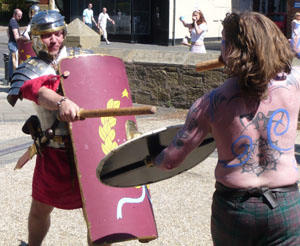
Many people have heard the stories of Julius Caesar crossing the Channel in 55 BC. Most of us particularly like the account which describes our ancestors, painted with woad, striking fear into the hearts of the legendary Roman legionaries. However, the real history of the Roman occupation began with a determined war of conquest by the Emperor Claudius in 43 AD.
Yet even twenty years after the original British tribes were not completely assimilated to the Roman Empire. In 60 AD there was a revolt by the Iceni, an East Anglian tribe, led by their queen, whose names was pronounced Boudicca, but whom we usually call Boadicea. You can see a picture on this page of this fiery woman, though it is more inspiring than accurate.
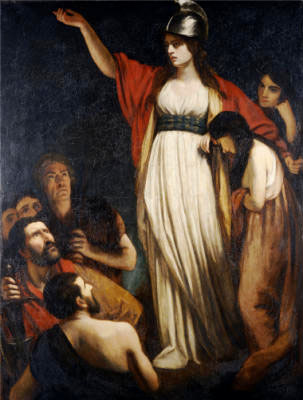
Boadicea Haranguing the Britons by John Opie, R.A. (1761-1807)
Legend has it that her last battle was at Battle Bridge – roughly where the gas holders near King’s Cross used to stand. She was killed, and the legend continues that she was buried under what is now Platform 10 of King’s Cross station. Unfortunately the accounts of Roman historians make this unlikely.
The capital of Roman Britain was Londinium, which is now basically the area covered by the City of London. It is a fascinating story and you will find out much more about this here:
It is also worth visiting the Museum of London to see their recreations of Roman life.
Though no villas have been found in this area, it is almost certain that Romans walked through our estate, since there must have been farms which provided Londinium with food. The nearest known Roman roads are the A1 (Archway Road) and the A5 (Edgware Road). But it seems clear that what are now St Pancras Way, Camden High Street and York Way must have been well used tracks.
Also traders are likely to have used the River Fleet. The mouth of the river was a major landing area for shipping, and small craft were certainly able to come up as far as modern Kentish Town. An anchor (not Roman) was found in the bed of the river behind the Castle Inn (now The Flowerpot).
In 410 AD Rome came under attack from the Visigoths, a Germanic tribe led by their king, Alaric. The Roman legions were recalled, and never returned, so leaving Britannia (their name for our country) open to other predators.